
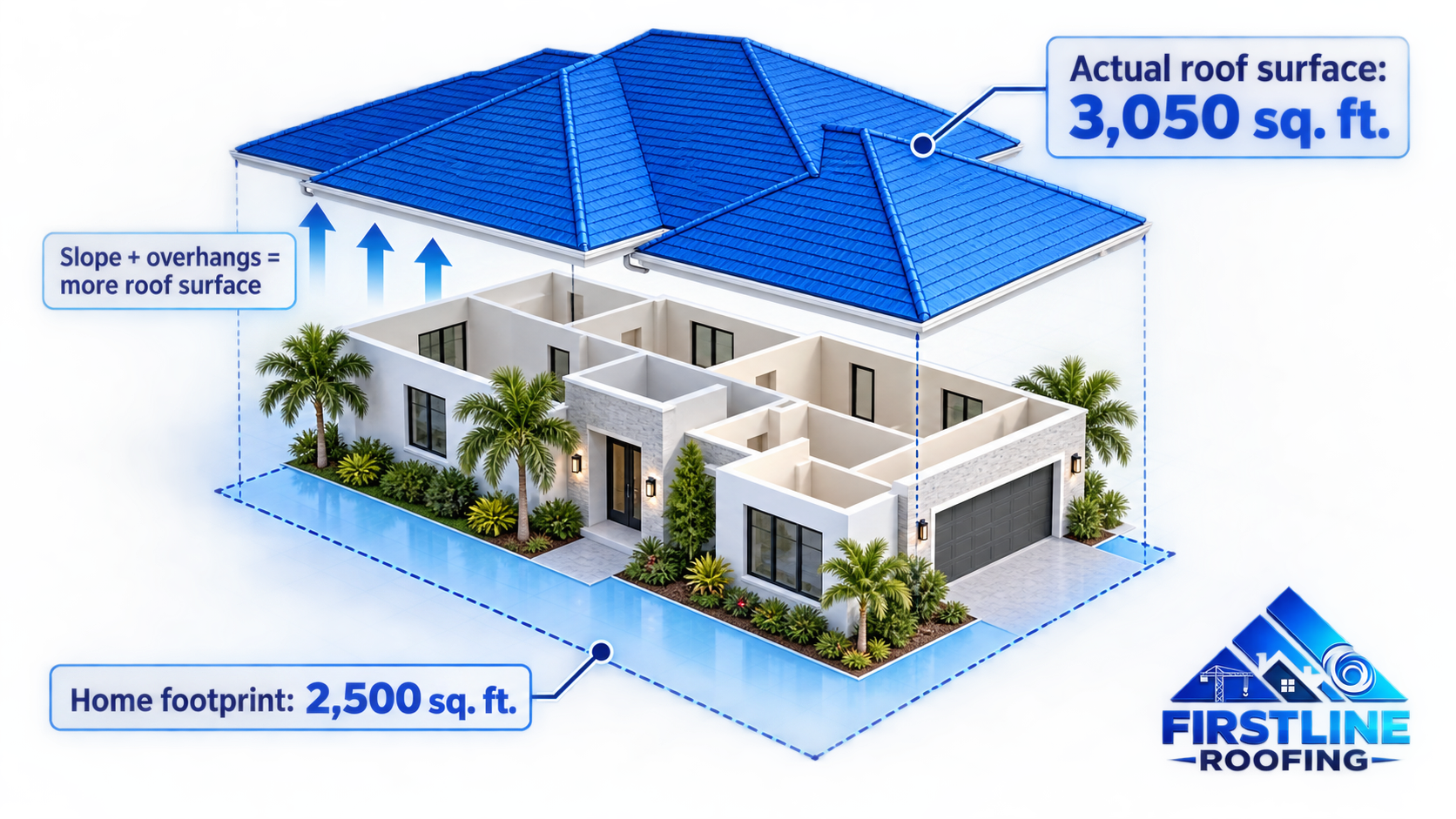
One of the most common questions we hear is, “My house is 2,500 square feet. Why does the roofing estimate show more than that?”
The answer is simple: your home’s square footage and your roof’s square footage are measuring two completely different things.
Your home’s stated square footage usually refers to the finished, air-conditioned living space inside. A roofing estimate measures the actual exterior surface of the roof that needs to be removed, waterproofed, and covered.
For many one-story homes in Parkland and throughout South Florida, the roof is larger than the home’s living area because of roof slope, overhangs, garages, covered entries, patios, and other roofed spaces.
Your Home’s Square Footage Usually Means Living Area
When a home is listed as 2,500 square feet, that is usually the interior conditioned living area. It does not necessarily include:
- Roof overhangs
- Attached garages
- Covered patios or lanais
- Covered entryways
- Porte cocheres
- Pool-bath roofs
- Roof pitch or slope
- Valleys, ridges, dormers, skylights, chimneys, and wall transitions
Those details matter because roof materials are installed over the actual roof surface, not the floor plan underneath it.
The Rise of the Roof Creates More Surface Area
Think of a roof like a ramp. The horizontal area beneath it may measure 1,000 square feet, but the actual roof surface is longer because it rises from the eave to the ridge.
Roofers use a pitch factor, also called a slope multiplier, to calculate that additional surface area:
Actual roof area = horizontal roof area × slope factor
Roof Pitch
Approximate Slope Factor
1,000 Sq. Ft. Flat Area Becomes
3:12
1.03
1,030 sq. ft.
4:12
1.05
1,054 sq. ft.
5:12
1.08
1,083 sq. ft.
6:12
1.12
1,118 sq. ft.
8:12
1.20
1,202 sq. ft.
10:12
1.30
1,302 sq. ft.
That difference is not extra padding in an estimate. It is real roof surface that requires underlayment, flashing, fasteners, labor, disposal, and roofing material.
Why One-Story Roofs Are Often Larger Than the Home
For one-story homes, the interior living area may be close to the footprint of the house, but the roof often extends beyond the exterior walls. Even a 12- to 24-inch overhang around the perimeter adds meaningful roof area before roof slope is factored in.
Then add attached garages, covered patios, entryways, and other non-air-conditioned areas that still need roofing. Once the slope is applied, the measured roof area is often substantially greater than the home’s advertised living square footage.
This is especially common on larger Parkland homes with tile roofs, multiple elevations, covered outdoor spaces, and more detailed roof layouts. A home may look straightforward from the ground, but the roof itself can have many separate planes, hips, valleys, and transitions.
For more local roofing guidance, visit our Parkland roofing page.
The Important Exception: Two-Story Homes
A roof is not always larger than the total square footage of a home.
A 4,000-square-foot two-story house may have only a 2,000-square-foot upper footprint. Even after adding overhangs and slope, the actual roof area may be much less than the home’s total living area.
That is why a contractor should never price a roof by simply using the square footage shown on a real-estate listing, tax record, appraisal, or closing paperwork. Those figures are helpful background, but they are not an actual roof measurement.
Roof Complexity Also Changes the Scope
Two roofs can have the same square footage but require very different amounts of labor and materials.
A simple gable roof is generally more straightforward than a roof with multiple valleys, dormers, skylights, chimneys, wall flashings, steep sections, or low-slope transitions. Tile roofs also require detailed attention to the waterproofing system beneath the tile, including underlayment, flashing, edge metal, fasteners, and transition details.
That is why a professional roofing estimate should account for both the actual measured roof area and the complexity of the roof system.
For statewide code information, homeowners can review the Florida Building Code resources. Project-specific requirements are confirmed through the applicable building department and permit process.
What Is a Roofing Square?
Roofing is commonly measured in “squares.”
One roofing square equals 100 square feet of roof surface.
For example, a 3,000-square-foot roof equals 30 roofing squares before material-specific waste, cuts, and layout requirements are considered.
How We Measure a Roof
A professional roof measurement may begin with aerial or satellite measurement technology, but it should be reviewed against the actual property. The final scope should account for roof planes, pitch, overhangs, attached structures, roof complexity, and areas that may not appear clearly on a property record.
At FirstLine Roofing, we explain the measurement in plain English. If your estimate shows more square footage than your home’s listed size, we will show you why. The number should be traceable to the actual roof, not a guess.
Frequently Asked Questions
Is my roof always bigger than my house?
No. A one-story roof is often larger than the home’s living area because of slope, overhangs, and roofed non-living spaces. A two-story home can have a roof that is much smaller than the total interior living area.
Does roof pitch increase the cost of a roof replacement?
Yes. A steeper roof creates more surface area and can increase labor, access, safety requirements, material handling, and installation time.
Why doesn’t my property record match my roofing estimate?
Property records generally focus on land, building, and interior living-area data. A roofing scope must measure the actual exterior roof surface that is being protected.
Can FirstLine Roofing measure my roof before providing an estimate?
Yes. We provide roof inspections and site-specific estimates for roof repairs, replacements, and storm-related roofing needs throughout Parkland and South Florida.
Get a Clear Roof Measurement Before Comparing Estimates
If you are comparing roofing estimates, make sure every contractor is measuring the same roof surface and clearly identifying what is included. A lower number based on an inaccurate measurement can quickly become a surprise later.
FirstLine Roofing provides clear, site-specific roofing guidance for homeowners who want a real scope, not a guess. Call 954-282-5224 to schedule an inspection.
Certified Roofing Contractor: CCC1334142
Certified General Contractor: CGC1530039