
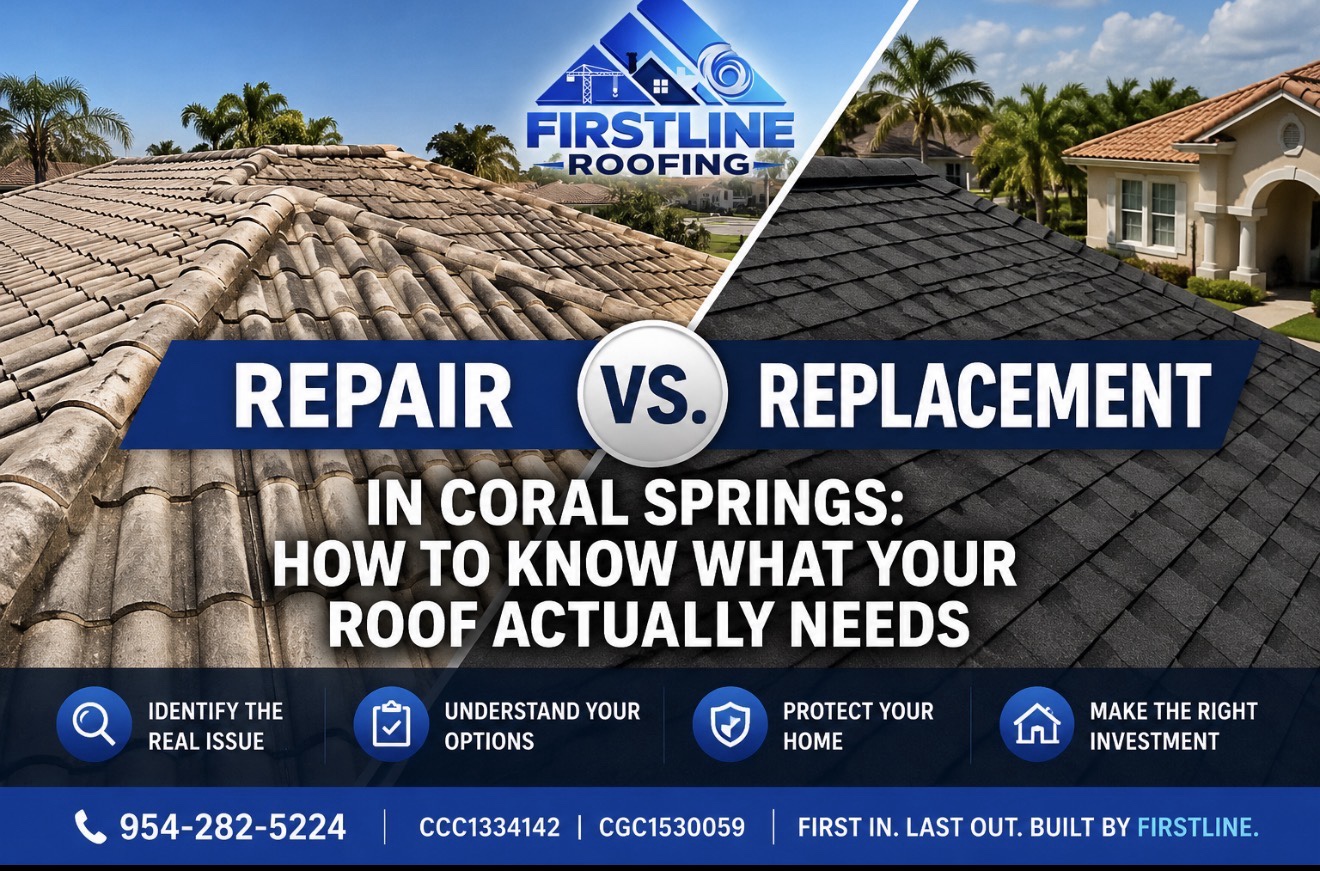
A roof problem does not automatically mean you need a new roof.
In South Florida, homeowners are frequently faced with that question after discovering a leak, cracked or displaced tile, missing shingles, deteriorated flashing, or staining on a ceiling. Sometimes the right solution is a targeted repair. In other situations, continuing to repair an aging or deteriorated roofing system only delays an inevitable replacement.
The important part is determining why the roof is failing, how widespread the problem is, and whether a repair can reasonably restore the integrity of the roofing system.
For homeowners in Coral Springs and the surrounding Broward County area, those decisions are also influenced by Florida’s climate, building requirements, material availability, and the way our roofs age under years of intense sun, heavy rain, humidity, and tropical weather.
At FirstLine Roofing, we evaluate the condition of the entire roofing system before recommending a repair or replacement. The goal should not be to sell the largest project. It should be to determine the appropriate scope of work based on the actual condition of the roof.
If you’re experiencing a roofing issue locally, learn more about our roofing services in Coral Springs or call 954-282-5224 to schedule an evaluation.
When Does a Roof Leak Only Require a Repair?
A localized roof leak can often be repaired when the underlying roofing system remains in serviceable condition.
The key word is localized.
For example, water intrusion may originate around:
- Plumbing vents and roof penetrations
- Flashing transitions
- Valleys
- Displaced or broken roof tiles
- Damaged shingles
- Roof-to-wall intersections
- Previous repair areas
- Mechanical equipment or penetrations
- Small sections damaged by wind or falling debris
A competent roof inspection should attempt to identify the source of the intrusion rather than simply addressing the location where water appears inside the building.
That distinction matters because the point where water enters a building is not necessarily directly above the visible interior damage. Water can travel along roof decking, framing members, fasteners, or other components before becoming visible inside.
That is one reason diagnosing roof leaks correctly requires more than looking at a ceiling stain.
Signs That Roof Repair May Be the Better Option
A repair may make sense when the roof is otherwise performing well and the damage is limited to a defined area.
Some common indicators include:
The Roof Is Relatively Young
If a properly installed roofing system is still well within its expected service life, replacement may be unnecessary unless significant damage or systemic failure is present.
Damage Is Confined to One Area
A handful of broken tiles, a localized flashing failure, or an isolated penetration problem may be repairable without disturbing large portions of the roof.
The Roof Deck Is Still Sound
Once damaged or deteriorated decking becomes widespread, the scope of work can change significantly. Localized damage, however, can often be addressed as part of a properly designed repair.
There Is No Pattern of Recurring Leaks
One isolated leak is very different from repeated water intrusion occurring in multiple areas.
When a roof requires frequent repairs, the cumulative cost and continued risk should be considered when deciding whether replacement is becoming the more practical option.
When Should You Consider Replacing the Roof?
Roof replacement becomes a stronger consideration when problems are no longer isolated.
A roof is a system. Its covering, underlayment, flashing, penetrations, decking, drainage characteristics, and attachment methods all work together.
When deterioration becomes widespread, repairing one visible failure may not address the condition of the rest of the system.
Multiple Areas Are Failing
Leaks appearing in several unrelated portions of the home can indicate broader deterioration.
Repairs Are Becoming Frequent
If you’re calling a roofer repeatedly, it may be time to compare the cost of continuing repairs against replacement.
A $1,000 or $2,000 repair can make sense on an otherwise healthy roof. Repeating those repairs across multiple areas over several years can become a different financial calculation.
The Roofing System Is Approaching the End of Its Useful Life
Age alone should not determine whether a roof requires replacement.
Two roofs installed in the same year can perform very differently depending on installation quality, ventilation, exposure, maintenance, materials, storm history, and previous repairs.
Age should therefore be considered alongside the roof’s actual physical condition.
The Underlayment Is Deteriorating
This is particularly important with tile roofing.
Concrete or clay tiles are the most visible component, but the water-shedding system beneath them is critical. A roof may still look relatively good from the street while its underlying components are deteriorating.
Replacing individual tiles will not correct widespread failure of the system underneath them.
Tile Roofs in Coral Springs Require a Different Evaluation
Tile roofing is extremely common throughout Coral Springs, Parkland, Coconut Creek, and surrounding South Florida communities.
It also creates a situation homeowners frequently misunderstand.
A broken tile does not necessarily mean the roof is leaking, and replacing a broken tile does not necessarily solve a leak.
The tile is only one component of the assembly.
When evaluating a tile roof, a roofing contractor may need to consider the condition of the tiles, underlayment, flashings, valleys, penetrations, attachment system and roof deck.
Another issue with older tile roofs is matching existing material.
Tile profiles and colors change over time, and some products are discontinued entirely. Even when the correct profile remains available, newly manufactured tiles may not perfectly match material that has spent years exposed to Florida sunlight and weather.
This can affect both the feasibility and appearance of a repair.
What About Shingle Roofs?
Asphalt shingle roofs can also experience localized failures that are appropriate for repair.
Missing shingles after high winds, isolated flashing issues, damaged pipe boots, and smaller areas of physical damage may be repairable when the remainder of the system is performing properly.
More widespread symptoms can indicate a different problem.
These may include extensive granule loss, widespread lifting or deterioration, repeated leaks, exposed or damaged areas, or deterioration affecting multiple roof slopes.
Again, the decision should be based on the overall roofing system rather than a single symptom.
Florida Building Code Matters
Roofing work in Florida is subject to state and local building requirements, and those requirements have changed considerably over the years.
The Florida Building Commission maintains information regarding the Florida Building Code and applicable technical requirements.
Depending on the scope of work, permitting and code requirements can affect how a roofing project must be completed.
This is another reason homeowners should be cautious about extremely inexpensive repairs performed without determining whether the proposed work is appropriate for the existing roofing system.
Why South Florida Roofs Take So Much Abuse
A roof in Coral Springs operates in a demanding environment.
During a typical year, it may be exposed to:
- Extreme ultraviolet radiation
- High surface temperatures
- Heavy rainfall
- Wind-driven rain
- High humidity
- Tropical storms and hurricanes
- Rapid temperature changes
- Organic growth and accumulated debris
Florida’s hurricane exposure also makes proper roof installation and maintenance particularly important.
The National Hurricane Center provides official tropical weather forecasts and preparedness information during hurricane season.
Homeowners should ideally address known roofing deficiencies before a tropical system threatens South Florida rather than discovering them during a major rain and wind event.
Don’t Wait for a Small Leak to Become an Interior Construction Project
One of the most expensive mistakes homeowners make is ignoring minor water intrusion.
A roofing problem does not remain confined to the roof simply because that’s where it started.
Continued moisture intrusion can affect insulation, drywall, ceilings, framing, finishes, electrical components, and other building materials. Depending on the conditions and duration, secondary moisture-related problems can develop as well.
Addressing the source early can dramatically reduce the amount of work required inside the home.
This is where working with a contractor that understands both roofing and general construction becomes valuable.
FirstLine operates as both a Florida Certified Roofing Contractor and Certified General Contractor, allowing our team to evaluate roofing problems within the larger context of the building rather than treating the roof as an isolated component.
Repair or Replace? Start With the Right Question
Instead of asking:
“Can this roof be repaired?”
A better question is:
“Does repairing this roof make sense?”
Almost anything can be patched temporarily.
That does not necessarily make it a good investment.
A professional evaluation should consider the location and cause of the failure, overall roof condition, remaining service life, previous repairs, condition of the underlying components, material availability, and the expected longevity of the proposed repair.
From there, a homeowner can make an informed decision.
Need a Roofer in Coral Springs?
If you’ve discovered a roof leak, damaged tile, missing shingles, or another roofing concern, FirstLine Roofing provides professional roof inspections, roof repairs, and complete roof replacement services throughout Coral Springs and surrounding South Florida communities.
Our roofing capabilities include:
- Tile roofing
- Asphalt shingle roofing
- Metal roofing
- TPO roofing
- PVC roofing
- Modified bitumen systems
- Roof coatings
- Roof repairs
- Leak investigation
- Residential roof replacement
- Commercial roofing
As part of FirstLine Construction Corp., our team brings roofing and general construction experience together under one company.
FirstLine Construction Corp.
Florida Certified Roofing Contractor CCC1334142
Florida Certified General Contractor CGC1530059
954-282-5224
Learn more about FirstLine Roofing and our Coral Springs roofing services or contact our team to schedule a roof evaluation.
First in. Last out. Built by FirstLine.