Most homeowners look at the large, visible sections of their roof when trying to determine whether it is in good condition.
Roofing contractors tend to pay very close attention to the details.
One of those details is the roof valley.
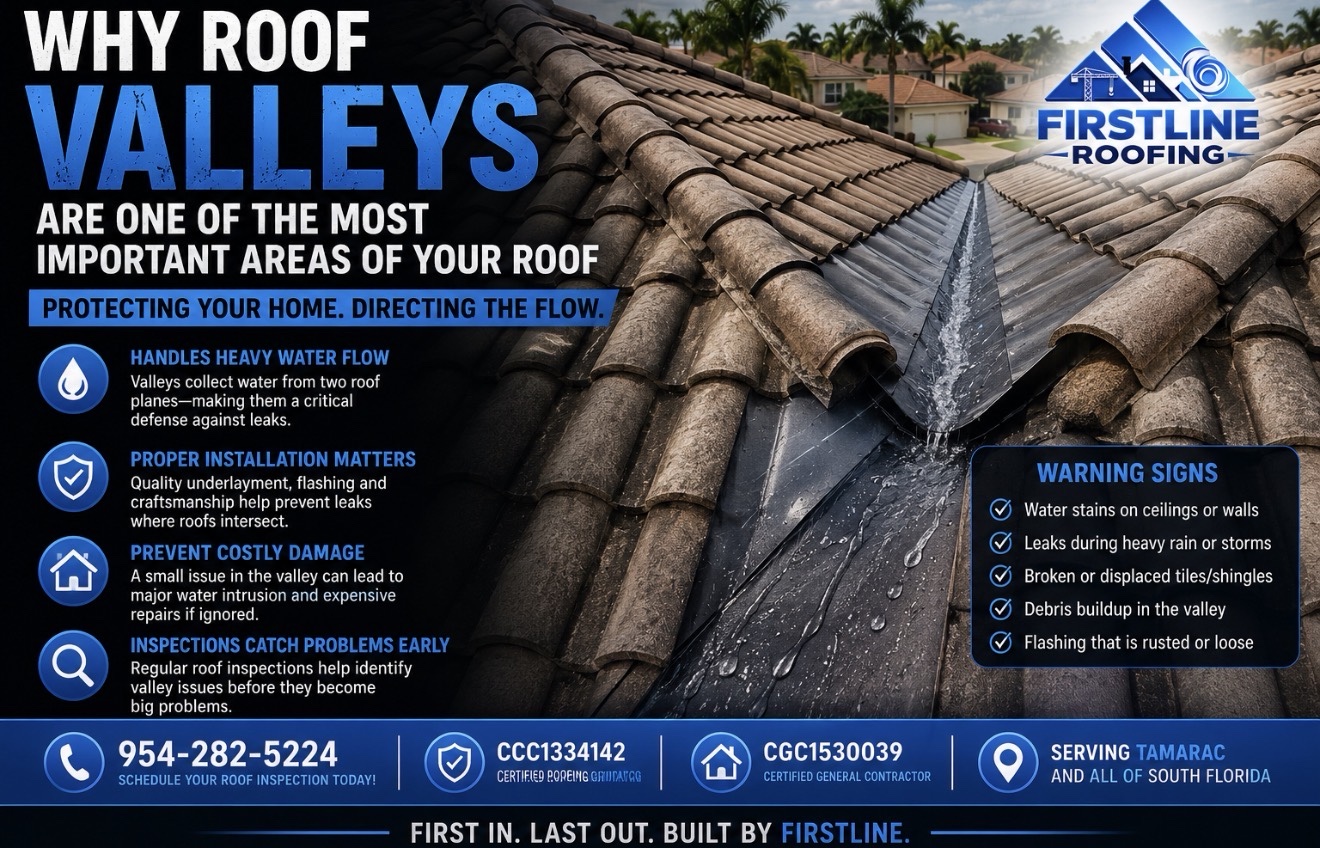
A roof valley is created where two sloping roof sections intersect, forming a channel that directs rainwater toward the lower edge of the roof. During one of South Florida’s heavy thunderstorms, a significant amount of water can be concentrated through these relatively narrow areas.
That makes valleys one of the hardest-working parts of many residential roofing systems.
When a valley is properly designed, installed and maintained, most homeowners will never think about it. When something goes wrong, however, a relatively small deficiency can become the source of significant water intrusion.
For homeowners throughout Tamarac and Broward County, understanding how valleys work can help explain why certain roof leaks occur and why repairing the visible roofing material isn’t always enough.
FirstLine Roofing provides roof inspections, repairs and complete roofing systems throughout South Florida. Property owners in the area can learn more about our Tamarac roofing services.
What Exactly Is a Roof Valley?
Look at a roof with multiple slopes, hips, dormers or intersecting sections.
Where two inward-sloping roof planes meet, they create a valley.
The valley’s job is straightforward: collect water from the adjoining roof surfaces and move it safely toward the drainage edge of the roof.
But consider what happens during a South Florida downpour.
Rain isn’t falling only on the valley itself. Water from portions of two separate roof planes may be moving toward the same channel.
That concentration of runoff is exactly why valley construction matters.
A problem that might remain relatively minor in another area of a roof can become much more noticeable when it occurs directly in a major drainage path.
Why Roof Valleys Deserve Extra Attention in South Florida
South Florida doesn’t exactly specialize in gentle rain.
Our roofing systems regularly encounter intense rainfall, wind-driven rain, tropical systems, high temperatures and significant UV exposure.
During heavy rainfall, valleys need to move water efficiently without allowing it beneath the roofing assembly.
That’s why a professional roof inspection shouldn’t consist of simply walking around looking for cracked tile or missing shingles.
We want to know how the entire water-shedding system is performing.
That includes valleys.
The Tile Isn’t the Whole Waterproofing System
This is particularly important on concrete and clay tile roofs.
Many South Florida homeowners naturally assume the tile itself is what keeps their house waterproof.
It’s more complicated than that.
Tile serves an important role in shedding water and protecting the assembly, but the components beneath and around the tile are critical to the system’s performance.
FirstLine’s tile roofing guide explains why underlayment, flashing and other components deserve just as much attention as the visible tile.
This becomes especially important at valleys.
A valley may look reasonably normal from the ground while problems are developing beneath or between the visible roofing materials.
Why Do Roof Valleys Leak?
There isn’t one universal cause.
A leaking valley can result from deterioration, physical damage, installation deficiencies, debris accumulation or problems with the surrounding roofing system.
Here are several conditions we look for.
1. Deteriorated Underlayment
Underlayment doesn’t remain new forever.
Years of heat, moisture exposure and normal aging can eventually affect roofing components beneath the visible covering.
Because valleys handle concentrated water flow, deterioration in these areas deserves particular attention.
Simply replacing a nearby cracked tile doesn’t address deteriorated waterproofing underneath it.
2. Problems With Valley Flashing
Depending on the roofing system and approved installation, valleys may incorporate metal flashing and other water-management components.
Those details matter.
Florida roofing requirements specifically address valley construction and flashing. The Florida Building Commission’s roofing provisions contain detailed requirements for valley materials and installation in applicable roofing assemblies.
That’s a good illustration of an important roofing principle:
The details you barely notice from the street can be some of the most technically important parts of the roof.
3. Debris Accumulation
Leaves, branches and other debris can collect in valleys.
This is particularly common around homes with mature landscaping.
Debris can interfere with normal drainage and hold moisture against portions of the roofing system.
Homeowners should not climb onto their roofs to clear difficult areas themselves. Tile can break under foot traffic, steep roofs create obvious fall hazards, and walking in the wrong location can cause additional damage.
If significant debris is accumulating, have the roof safely evaluated and cleaned as appropriate.
4. Broken or Displaced Tile Near the Valley
One cracked tile doesn’t automatically mean the entire roof has failed.
But tile damage around a valley deserves attention because of the amount of water moving through that area.
Broken or displaced pieces can change how water travels across the roof and may expose underlying components to additional weathering.
5. Previous Repairs
Valleys are also areas where we sometimes find evidence of prior repairs.
Sealant and roofing cement have legitimate uses within roofing assemblies when installed where specified.
But simply covering a problem with more material isn’t the same thing as correcting the underlying condition.
If a valley has been repaired repeatedly and continues to leak, the question becomes:
Why does it keep failing?
That’s the question worth answering.
Why Valley Leaks Can Be Difficult to Diagnose
Here’s where homeowners can get frustrated.
The ceiling stain inside the house doesn’t necessarily sit directly below the exterior failure.
Once water enters a roofing assembly, it can travel.
It may move along decking, framing or another building component before becoming visible inside the home.
That means the location of the interior damage gives us useful information, but it doesn’t automatically identify the precise exterior entry point.
This is why roof diagnostics should involve more than finding the nearest cracked tile.
We may evaluate:
- Valley conditions
- Adjacent roof slopes
- Underlayment
- Flashings
- Penetrations
- Roof-to-wall intersections
- Previous repairs
- Accessible roof decking
- Interior or attic moisture patterns
The goal is to follow the evidence.
Valleys and Wind-Driven Rain
Heavy vertical rainfall is one challenge.
Wind-driven rain is another.
During severe South Florida weather, water doesn’t always travel neatly downward. Wind can push rain across roof surfaces and against transitions, flashings and other vulnerable details.
That’s one reason a leak might appear during one storm but not another.
Rainfall intensity, duration and wind direction can all change how water interacts with a roof.
If you’ve experienced that type of intermittent problem, our article on roof leaks after heavy South Florida rain goes deeper into why a roof can leak without an obvious hole or missing roofing material.
What About Shingle Roof Valleys?
Valleys aren’t only a tile-roof concern.
Architectural shingle roofs also require properly constructed valley details.
The exact configuration can vary depending on the roofing system, manufacturer requirements and approved installation method.
The principle remains the same:
Water from intersecting roof planes needs a reliable path off the roof without entering the assembly.
During an inspection, we’re interested not only in whether shingles are present, but also their condition and how the valley itself has been constructed and is performing.
Can a Leaking Valley Be Repaired?
Sometimes, absolutely.
A valley problem does not automatically require a complete roof replacement.
If the deficiency is localized and the surrounding roofing system remains serviceable, a properly designed repair may be the appropriate solution.
But the extent of the problem matters.
If the underlayment is deteriorated throughout large portions of an older roof, or several areas are beginning to fail simultaneously, repairing one valley may not address the larger condition.
This is why FirstLine evaluates repair versus replacement based on the roof as a system rather than simply its age.
Our roof replacement information explains what we evaluate when a roofing system has reached the point where larger-scale work may make more sense.
Watch for These Warning Signs
You don’t need to become a roofing expert to recognize when something deserves professional attention.
Possible warning signs include:
- Ceiling staining near intersecting roof areas
- Water intrusion during particularly heavy rain
- Recurring leaks after previous repairs
- Broken or displaced tiles near a valley
- Visible debris collecting in valleys
- Deteriorated or displaced roofing material
- Interior staining that continues to expand
- Visible deterioration of accessible roof decking
- A roof leak that appears only when rain comes from a particular direction
None of these automatically proves the valley is responsible.
They tell us it’s time to investigate.
Florida Roofing Requirements Continue to Evolve
Florida maintains extensive requirements for roof assemblies because of the environment in which our buildings operate.
As of August 2026, the Florida Building Commission identifies the 8th Edition (2023) Florida Building Code, effective December 31, 2023, while also publishing materials related to the upcoming 9th Edition (2026).
Homeowners don’t need to memorize roofing code.
That’s the contractor’s job.
But it is one reason roofing details shouldn’t be improvised in the field.
Approved materials, manufacturer requirements, Florida Product Approvals and applicable building-code provisions all matter when constructing or repairing a roofing system.
For current technical information, homeowners and construction professionals can use the Florida Building Commission’s official code resources.
Roof Geometry Matters More Than Most Homeowners Realize
Two homes with the same roofing material can place very different demands on that material.
A simple roof with relatively few transitions is different from an architectural roof containing multiple hips, valleys, walls, penetrations and intersecting sections.
Every transition introduces another detail that has to manage water correctly.
That’s why roofing isn’t simply a matter of calculating square footage and installing material over it.
Roof complexity matters.
A 4,000-square-foot roof with numerous valleys and transitions can require substantially more detailing than a simpler roof of similar size.
And in South Florida, those details have to perform during some of the most demanding rainfall and wind conditions in the country.
The Best Time to Find a Valley Problem Is Before the Ceiling Tells You
Roof problems are usually easier to address before they become interior construction problems.
Once water enters the building, the scope can extend beyond roofing into decking, insulation, drywall, paint and other finishes.
That is particularly relevant for aging South Florida roofs.
If you have an older tile or shingle roof, recurring leaks, visible valley deterioration or simply aren’t sure of the roof’s condition, an inspection can provide a much clearer picture of what’s happening.
Need a Roof Inspection in Tamarac or South Florida?
FirstLine Roofing provides roof inspections, leak diagnostics, repairs and complete roof replacements throughout Tamarac and communities across Broward, Palm Beach and Miami-Dade counties.
Our team works with:
- Concrete and clay tile roofing
- Architectural shingles
- Metal roofing
- TPO and PVC systems
- Modified bitumen
- Roof coatings
- Residential roofing
- Commercial roofing
- Roof repairs and leak investigation
Whether the issue is a valley, flashing detail, penetration, underlayment or something else entirely, our approach is the same:
Find the actual source before recommending the solution.
FirstLine Roofing
Certified Roofing Contractor CCC1334142
Certified General Contractor CGC1530039
954-282-5224
Serving Tamarac and communities throughout South Florida.